

Running a creative business can leave you pulled in every direction at once. You want to focus on your craft, but there are tough decisions around pricing, marketing, and finding your ideal customers. Without clear strategies, it's easy to feel stuck and unsure how to grow in the Irish creative sector.
This guide is built to make your journey easier. You will discover practical steps for defining your unique value, structuring your prices for profit and sustainability, and connecting with clients in a way that feels natural. Each insight draws from proven approaches used across cultural and creative industries throughout Europe.
Get ready to uncover methods that help you build a sustainable, rewarding business as an Irish creative. The next sections reveal actionable solutions that move your creative work forward and connect it with people who truly value what you do.
1. Define Your Unique Value and Audience
Before you can sell anything, you need to know exactly what sets your work apart and who genuinely needs it. This is the foundation everything else rests on.
When you understand your unique value, you stop competing on price alone. Instead, you build a business around what makes your craft distinctly yours. For Irish creatives, this means recognising that your perspective, your techniques, and your story are your competitive advantage.
Let's break this down into actionable steps.
Know Your Ideal Audience
Your audience isn't "everyone." The sooner you accept this, the stronger your business becomes. Research shows that identifying your target market is fundamental to creating offerings that resonate.
Start by thinking about who benefits most from your work. Are they interior designers sourcing bespoke pieces? Gift buyers looking for handmade items with personality? Corporate clients needing custom artwork?
Ask yourself these questions:
- Who currently buys from you (or similar creators)?
- What problem does your work solve for them?
- What's their budget range?
- Where do they spend their time online and offline?
The more specific your answers, the clearer your direction becomes. If you're a jeweller, your audience might be "women aged 28-45 who value sustainable, locally-made pieces" rather than simply "people who like jewellery."
Knowing your ideal audience transforms how you market, price, and develop your work.
Clarify What Sets You Apart
Your unique value proposition is the combination of benefits only you offer. This isn't about claiming you're the best, it's about naming what's genuinely different.
Maybe your embroidered textiles combine traditional Irish motifs with contemporary design. Perhaps your pottery uses locally-sourced clay and sustainable glazes. Your jewellery might tell stories rooted in Irish heritage.
To define yours:
- List what your work actually does (beyond existing)
- Note techniques or materials that are distinctly yours
- Identify the transformation your customers experience
- Consider your background, values, or location as differentiators
According to guidance on defining your unique value proposition, this clarity helps you communicate benefits effectively and build lasting customer relationships.
Analyse Your Competitive Space
Understanding what others offer isn't copying them, it's positioning yourself strategically. Look at creators making similar work. What are they emphasising? How do they price? What gap exists that you could fill?
You might discover that most competitors focus on volume, whilst you could emphasise bespoke commissions. Or they compete on lowest price, whilst you compete on story and craftsmanship.
This isn't about undermining anyone. The cultural and creative industries thrive when entrepreneurs identify their distinctive offerings within diverse markets. Your positioning simply makes you findable to the right people.
Pro tip: Create a simple one-sentence statement describing who you serve and what problem you solve for them, then use this as your north star when making business decisions.
2. Structure Pricing for Profit and Sustainability
Most creative entrepreneurs underprice their work. You pour hours into craft, materials, and expertise, then charge a price that barely covers costs. This approach kills businesses quietly.
Pricing isn't just about covering expenses. It's about building a sustainable business that rewards your skill and allows you to keep creating. When structured properly, pricing becomes your profit engine.
The challenge is balancing what customers will pay with what you actually need to earn. This requires moving beyond guesswork into a strategic approach.
Calculate Your True Costs
You need to know every cost involved in producing your work. This includes materials, tools, labour, studio rent, packaging, and the hidden costs most creatives ignore.
Material costs are obvious. Labour is trickier. Many makers calculate only their "hands-on" time, forgetting design hours, sourcing time, and admin work. Your pricing must reflect the complete picture.
Create a simple cost breakdown for each product or service:
- Direct materials (clay, thread, paint, paper)
- Equipment depreciation and maintenance
- Packaging and shipping supplies
- Studio or workspace costs per item
- Your hourly labour rate (not just minimum wage)
- Business expenses (insurance, software, website)
Tools like a pricing calculator can help you systematise this process rather than estimating mentally each time.
Apply Value-Based Pricing
Once you understand costs, you can price based on value. Sustainable pricing strategies balance profitability with ethical considerations, reflecting what customers genuinely receive from your work.
Value-based pricing asks: what transformation does your customer experience? If you're selling a handmade leather bag, you're not just selling leather. You're offering durability, craftsmanship, uniqueness, and the story of Irish artisanal creation.
Customers pay premium prices for perceived value. A bespoke illustration worth €500 to a business client may not feel expensive at all if it solves their branding problem.
Your price should reflect the genuine value you deliver, not just the hours spent.
Build in Profit Margins
Profit is what remains after all costs. Many creative businesses operate at a loss without realising it. You need clear profit targets, not hope that something will work out.
Industry standards suggest healthy margins:
- Handmade products: 2.5 to 3.5 times material and labour cost
- Services and bespoke work: 50 to 100% markup on total costs
- Digital products: 75% or higher margin
These margins fund reinvestment in your business, cover slow seasons, and actually pay you for running a business rather than just practising craft.
Communicate Your Value Transparently
When customers understand why your price is what it is, resistance drops dramatically. Share your story. Explain your process. Show what makes your work worth the investment.
Irish creatives have a distinct advantage here. Your heritage, your locally-sourced materials, your commitment to sustainability, your technique passed through generations—these are genuine value drivers that justify premium pricing.
Pro tip: Raise your prices in small increments (5 to 10% annually) rather than attempting one large jump, allowing existing customers to adjust whilst reflecting your growing expertise and market position.
3. Master Simple Sales and Marketing Strategies
Sales and marketing feel overwhelming when you're a maker focused on craft. You'd rather spend time creating than promoting. But without customers knowing you exist, your best work stays invisible.
The good news? You don't need complicated strategies or large budgets. Simple, consistent approaches work better than sporadic big pushes.
Tell Your Story, Not Just Your Product
Customers don't buy products in isolation. They buy the story behind them. Your background, your process, your values, and your why all matter more than technical specifications.
As a Irish creative, your story is inherently compelling. You might work with traditional techniques passed through generations. Your materials come from local suppliers. Your craft reflects cultural heritage or personal experience.
Share this authentically. When a customer buys your work, they're investing in that story as much as the object itself.
Your storytelling channels could include:
- Behind-the-scenes Instagram or TikTok content
- Email newsletters describing your process
- Product descriptions that explain the craft
- Video clips showing techniques or materials
- Posts sharing your inspiration and creative journey
Your story is your most powerful marketing asset.
Focus on Customer Relationships, Not Transactions
Strategic customer engagement builds lasting businesses more effectively than one-off sales. When customers feel genuinely valued, they return repeatedly and recommend you to others.
This means remembering repeat customers' names, asking what they need, offering personalised recommendations, and following up after purchase.
Relationship marketing is particularly powerful for creatives because your work is personal. Someone who bought a handmade gift from you five years ago might be searching for something similar now. They'll come back to you first if you've maintained that connection.
Practical relationship-building actions:
- Send thank you notes with purchases
- Create an email list and share updates genuinely
- Respond thoughtfully to customer messages
- Ask for feedback and actually implement suggestions
- Celebrate milestone orders with repeat customers
Use Content Marketing to Establish Authority
Content marketing means sharing useful information that positions you as someone who understands your craft deeply. This builds trust before anyone buys anything.
You might write a blog post about choosing quality materials, create a video tutorial on caring for handmade items, or share tips about styling artwork in a home. This content doesn't sell directly, but it demonstrates expertise and attracts customers who appreciate what you do.
Developing effective marketing management skills includes understanding how to position yourself through valuable content that draws people towards your work naturally.
Content ideas suited to creatives:
- How-to guides relevant to your field
- Before-and-after project showcases
- Q&A addressing common customer questions
- Trend commentary in your niche
- Stories of commissioned pieces and transformations
Keep It Consistent and Simple
Consistency matters more than complexity. Posting regularly on one platform beats sporadic efforts across five platforms. Responding to messages within 24 hours builds trust faster than waiting a week.
Choose one or two marketing channels where your customers actually spend time, then show up consistently there.
Pro tip: Batch-create your marketing content monthly, scheduling posts and emails in advance, so you maintain consistency without it consuming your creative time daily.
4. Embrace Effective Time and Project Planning
Creative work expands to fill available time. Without clear planning, you'll spend twelve hours on a project that should take four, missing deadlines and burning out in the process.
Time and project planning transforms chaos into clarity. You complete more work, meet commitments reliably, and actually enjoy your creative process again instead of constantly rushing.
Start With Clear Project Goals
Vague projects consume unlimited time. Specific goals create natural stopping points and help you prioritise ruthlessly.
Instead of "finish the commission," define exactly what done looks like. Is it ten finished pieces or twenty? Does it include revisions or are those separate? When is it due?
Using SMART goals helps tremendously. Your objective should be specific, measurable, achievable, relevant, and time-bound. This clarity prevents scope creep and allows you to estimate accurately how long work actually takes.
Example goal frameworks:
- "Complete five bespoke illustrations with two rounds of revisions by 15th March"
- "Design and list twelve new jewellery pieces on shop by end of month"
- "Create portfolio photography for ten existing products in next two weeks"
- "Finish the mural design including client approval by 20th April"
Clear project goals are the foundation of realistic planning.
Break Projects Into Manageable Stages
Large projects feel overwhelming. Breaking them into smaller phases makes them feel achievable whilst revealing where delays typically happen.
A pottery commission might break into: clay sourcing, clay preparation, hand-throwing, first firing, glazing, second firing, and packaging. Each stage has different demands and timeframes.
When you map stages this way, you can identify bottlenecks. Perhaps your kiln drying time is actually your constraint, not your creation time. Or maybe sourcing materials always takes longer than expected. Once visible, you can plan around these realities.
Effective project management practices emphasise planning, scheduling, and control methods that account for real constraints and resource availability, ensuring projects complete successfully and on time.
Typical project stages for creatives:
- Planning and design phase
- Material sourcing and preparation
- Active creation or production
- Quality review and revisions
- Photography or documentation
- Packaging and delivery
Implement Time-Blocking and Prioritisation
Without time boundaries, creative work bleeds into personal time endlessly. Time-blocking means assigning specific hours to specific tasks, protecting that time fiercely.
Morning hours typically suit focused creative work. Afternoons might suit admin, emails, and planning. Weekends stay sacred. Time management strategies tailored for creatives include time-blocking techniques and prioritisation frameworks that enhance productivity whilst maintaining creative flow.
Prioritisation prevents wasting hours on low-impact tasks. Ask yourself: which task moves my business forward most? Which is most urgent? Which is most profitable? Focus there first, then move to everything else.
Time-blocking template:
- Monday and Tuesday mornings: production work
- Wednesday mornings: new design and development
- Thursday: admin, customer communication, planning
- Friday: photography, shop updates, week review
Track Actual Time Versus Estimates
You'll discover you're terrible at time estimation initially. Everyone is. The key is learning from this gap.
When you finish a project, note how long it actually took versus what you estimated. After ten projects, patterns emerge. Hand-painting takes longer than you think. Photography consumes surprising amounts of time. Revisions nearly always exceed initial allowances.
This historical data becomes your planning superpower. Future estimates become accurate, deadlines become realistic, and you stop over-committing.
Pro tip: Create a simple spreadsheet tracking project type, estimated hours, actual hours, and completion date, then review quarterly to refine your planning accuracy and identify your genuine time constraints.
5. Build a Supportive Creative Community
Creative entrepreneurship can feel isolating. You're juggling production, admin, marketing, and customer service alone in your studio. But isolation breeds self-doubt and limits growth. Community changes everything.
A supportive creative community provides mentorship, collaboration opportunities, shared knowledge, and genuine encouragement when things get difficult. You stop feeling like you're the only one struggling with pricing or struggling to find customers.
Why Community Matters for Creative Entrepreneurs
Creative communities aren't luxuries. They're business infrastructure. Research shows that vibrant ecosystems for creative entrepreneurs foster innovation, facilitate knowledge exchange, and enable sustainable growth by connecting makers with opportunities and expanding networks.
When you're surrounded by other creatives facing similar challenges, you stop feeling broken. You realise pricing struggles are universal. Client communication difficulties are common. Seasonal income fluctuations affect everyone.
This shared understanding transforms your mindset. You move from "something's wrong with me" to "this is normal and solvable."
Community benefits include:
- Peer support and accountability
- Shared knowledge about what actually works
- Collaborative opportunities and cross-promotion
- Access to collective problem-solving
- Emotional encouragement during difficult periods
- Referral networks when you're overbooked
Find or Build Your Creative Tribe
Community takes many forms. You might join local maker networks, online creative groups, artist collectives, or craft associations. The best communities share your values and understand your specific challenges.
For Irish creatives, finding spaces specifically designed for your context matters. General entrepreneurship advice often misses the particular realities of creative work—the seasonal nature, the emotional investment, the difficulty of quantifying value in purely financial terms.
You could also start small. Invite two other creatives for monthly coffee to share challenges and wins. Create a WhatsApp group where you discuss pricing decisions. Organize a studio visit afternoon where makers show each other their spaces and processes.
Options to explore:
- Online communities and membership platforms
- Local artist collectives or maker spaces
- Industry-specific associations in your field
- Regional creative networks and meet-ups
- Informal peer groups you create yourself
The strongest communities are built deliberately, not discovered by accident.
Learn From Others' Experience
Mentorship and community-building activities accelerate your learning dramatically. Instead of spending years discovering what works through trial and error, you benefit from others' hard-won knowledge.
A mentor who's navigated business challenges ahead of you can save you from expensive mistakes. A peer who recently figured out sustainable pricing can show you their process. Someone who successfully scaled production can explain bottlenecks they encountered.
This knowledge transfer happens naturally when you're embedded in authentic community rather than consuming it passively.
Connect With Your Existing Audience
Your customers and followers form a latent community. Strengthening these connections transforms them from anonymous buyers into genuine supporters invested in your success.
Respond to comments thoughtfully. Share behind-the-scenes stories. Ask what they want to see next. Involve them in decisions. When people feel genuinely connected to you and your work, they become vocal advocates who recommend you enthusiastically.
You can explore communities of Irish makers and artists designed specifically to support creative entrepreneurs building sustainable businesses together.
Pro tip: Commit to one community space for at least three months before deciding if it's right for you, as genuine relationships and value typically emerge gradually rather than immediately.
6. Invest in Ongoing Learning and Self-Development
Your craft skills alone won't sustain a business. The creative industry evolves constantly. Customer preferences shift. Technology changes. New competitors emerge. Without continuous learning, you'll eventually fall behind.
Investing in your own development isn't a luxury, it's necessary maintenance for long-term success. The creatives thriving five years from now will be those who committed to learning today.
Why Continuous Learning Matters
Many creative entrepreneurs focus solely on improving their craft while neglecting business skills. But professional development in cultural and creative sectors requires ongoing learning across multiple areas including financing, governance, business models, and entrepreneurial skills essential for sustainability.
You need to develop as a businessperson, not just an artist. This means understanding finances, marketing, customer psychology, negotiation, and leadership. These skills directly impact profitability and business resilience.
Learning also prevents stagnation creatively. Exposure to new techniques, perspectives, and approaches refreshes your creative practice and keeps work feeling fresh for you and your audience.
Areas worth developing:
- Business fundamentals and financial management
- Advanced marketing and customer psychology
- New techniques within your craft
- Digital tools and technology relevant to your field
- Leadership and team management skills
- Strategic thinking and business planning
Identify Your Learning Gaps
You can't learn everything. Prioritise what actually impacts your business success most right now.
If pricing frustrates you constantly, invest in pricing strategy training. If social media confuses you, take a focused course on content creation. If you're overwhelmed by admin, learn systems and automation. Match learning to genuine business pain points.
Ask yourself honestly where your skills are weakest. Where do you avoid tasks because you lack confidence? What decisions paralyse you with uncertainty? Those areas offer the highest return on learning investment.
Smart entrepreneurs invest in learning what they don't know, not more of what they already do well.
Diverse Learning Methods
Learning doesn't mean expensive university programmes. Multiple pathways exist, depending on your learning style and budget.
Online courses offer flexibility and affordability. Workshops provide intensive focus and networking. Podcasts and blogs deliver bite-sized knowledge. Mentorship provides personalised guidance. Books offer deep dives. Conferences connect you with industry leaders and peers.
Mix methods for best results. You might take one formal course annually, listen to podcasts weekly, read one business book quarterly, and attend one conference yearly. This combination keeps learning active without overwhelming your schedule.
Learning options:
- Online courses and certifications
- Workshops and short intensives
- Podcasts and educational content
- Books and industry publications
- Mentorship and peer learning
- Conferences and professional gatherings
- Webinars and masterclasses
Apply Learning Immediately
Knowledge without application becomes forgotten trivia. When you learn something new, implement it within a week. Test it in your business. Evaluate what works. Discard what doesn't.
Professional development combining workshops and networking fosters continuous learning and cross-disciplinary collaboration, empowering creatives to develop business acumen and maintain competitive advantage through practical application.
This active learning cycle creates real business improvements rather than merely collecting certificates.
Pro tip: Schedule one hour weekly for learning and one hour monthly for implementing what you've learned, treating these commitments as seriously as client deadlines to ensure development progresses consistently.
Below is a comprehensive table summarising the key strategies and insights provided in the article for building a successful creative entrepreneurship endeavour.
| Topic | Insights | Actions |
|---|---|---|
| Defining Unique Value | Understand what sets your work apart and its distinctive qualities. | Reflect on your techniques, materials, and story to identify your value proposition. |
| Knowing Target Audience | Focus on a specific group that benefits the most from your work. | Analyse customer demographics, needs, and behaviours to create targeted offerings. |
| Strategic Pricing | Price to balance sustainability and perceived value critically. | Calculate all costs, determine profit margins, and set value-sensitive prices. |
| Engaging Marketing | Share your narrative to build connections and trust with customers. | Use platforms like newsletters and social media to communicate your craft and inspiration. |
| Community Development | Engage collaboratively with other creatives to foster support and learning. | Participate in networks, mentor programmes, and local artistic initiatives. |
| Continuous Learning | Develop both business and creative skills to adapt to challenges. | Enrol in courses, attend workshops, and read industry-specific materials to expand knowledge. |
| Time Management | Plan tasks clearly to improve productivity and prevent burnout. | Apply time-blocking techniques and SMART goals to structure work effectively. |
This table provides an overview of the article's actionable guidance for creative entrepreneurs pursuing lasting success.
Transform Your Creative Vision into a Thriving Business Today
The challenges of pricing fairly, building meaningful customer relationships, and managing time efficiently can leave many Irish creative entrepreneurs feeling overwhelmed and isolated. If you recognise these struggles from the article "6 Essential Tips for Creative Entrepreneurs to Boost Success" you are not alone. Your goal to build a sustainable, profitable business while honouring your unique artistic value is entirely achievable with the right support and guidance.
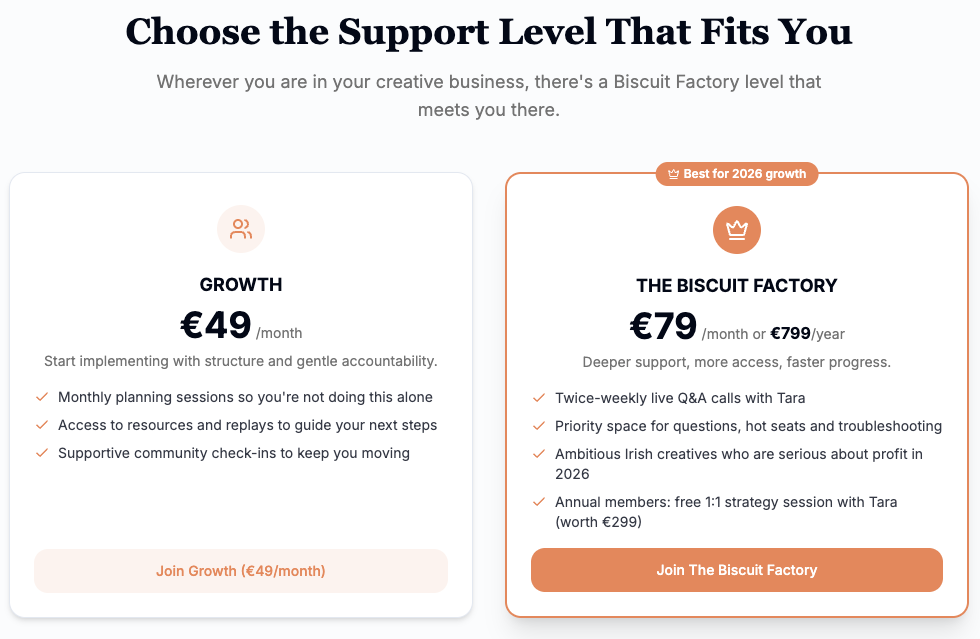
Join The Biscuit Factory, a vibrant Irish-based community designed explicitly for creatives like you. Here you will find practical resources on pricing strategies, sales techniques, and project planning along with live coaching and workshops tailored to your unique challenges. Take advantage of expert advice and peer support to confidently map out your growth for 2026, all within a collaborative space free from distracting algorithms. Don't let uncertainty or isolation hold back your creative business journey. Start exploring how to turn your craft into a flourishing enterprise now at The Biscuit Factory Blog. Your sustainable success begins with the right community and tools behind you.
Frequently Asked Questions
How can I define my unique value as a creative entrepreneur?
To define your unique value, list the specific benefits your work offers that others do not. Consider your techniques, materials, and personal story to articulate what truly sets you apart. Start by crafting a one-sentence statement reflecting your unique value proposition.
What steps should I take to identify my ideal audience?
To identify your ideal audience, ask who derives the most benefit from your work. Create detailed customer profiles by considering their demographics, preferences, and purchasing behaviours. Aim to narrow it down to a specific group to enhance your marketing strategies.
How should I structure my pricing to ensure profitability?
Structure your pricing by calculating all production costs, including materials, labour, and overheads. Then, apply value-based pricing to reflect the benefits your customers gain from your work. Set profit margins that align with industry standards to ensure sustainability and growth.
What simple marketing strategies can I implement to attract customers?
Utilise storytelling in your marketing by sharing the personal narrative behind your work and process. Focus on building customer relationships rather than just transactional interactions. Engage with your audience through social media or newsletters to create a loyal community around your brand.
How can I manage my time effectively as a creative entrepreneur?
To manage your time effectively, implement time-blocking methods to assign specific hours for different tasks. Break your projects into manageable stages with clear goals to avoid overwhelm and keep track of your progress. Schedule regular reviews to assess and adjust your productivity strategies.
Why is it important to invest in ongoing learning for my business?
Investing in ongoing learning allows you to stay updated with industry trends, enhance your skills, and address gaps in your knowledge. Prioritise areas that impact your business most, and apply what you learn immediately to reinforce your growth. Consider dedicating one hour weekly to learning new skills or techniques relevant to your craft.