
Ireland’s Creative Communities initiative has delivered over 5,700 projects nationwide, transforming how artists collaborate and grow their businesses. Yet many Irish creatives still struggle with isolation, pricing uncertainty, and accessing the funding that could sustain their work. This article clarifies how Irish artist communities function within Ireland’s unique creative ecosystem, debunks common misconceptions, and provides a practical roadmap to leverage community support for financial and professional success.
Key Takeaways
| Point | Details |
| Funding Access Quadruples | Arts Council funding for individual artists has quadrupled since 2020 through community initiatives. |
| Financial Investment Increases | Basic Income pilot recipients invest €550 more monthly into creative practice and gain 8 extra weekly hours. |
| Collaboration Expands Opportunities | Over 5,700 collaborative projects nationwide boost sales knowledge and market access. |
| Community Enhances Creative Freedom | Evidence shows collaboration expands rather than limits artistic autonomy and business confidence. |
| Practical Framework Exists | Multi-metric evaluation tools help artists measure community ROI against personal business goals. |
Introduction to the Role of Community for Artists in Ireland
Ireland’s creative sector operates within a distinctive ecosystem built around the Creative Ireland Programme. This national initiative has established local Culture and Creativity Teams in each of Ireland’s 31 local authorities to foster collaboration among artists and cultural groups. Each team develops five-year strategies tailored to regional creative needs, addressing everything from rural isolation to urban market saturation.
Yet despite this infrastructure, many Irish artists face significant challenges. Isolation remains widespread, particularly outside Dublin. Business skills like pricing, sales strategy, and financial planning often feel inaccessible or overwhelming. Traditional art education rarely covers these practical realities, leaving creatives to navigate commercial waters alone.
Understanding this ecosystem is essential to leveraging community support effectively. The structure includes:
-
Dedicated Culture and Creativity Teams with local authority backing
-
Cross-sector collaboration frameworks connecting artists, heritage groups, libraries, and enterprises
-
Targeted funding streams accessible primarily through community engagement
-
Regional strategies addressing specific local creative economy challenges
-
Business development resources tailored to Irish artists’ unique needs
This infrastructure transforms abstract community concepts into practical support systems. When you know how these pieces connect, you can strategically access resources that directly impact your bottom line and creative sustainability.
How Community Drives Financial and Professional Growth for Artists
The financial evidence for community engagement is compelling. Arts Council funding for individual artists in Ireland has quadrupled since 2020, driven primarily by community initiatives that connect creatives with funding opportunities. This isn’t coincidence. Community presence signals professionalism, demonstrates collaborative capacity, and provides the networks needed to learn about and navigate funding applications.
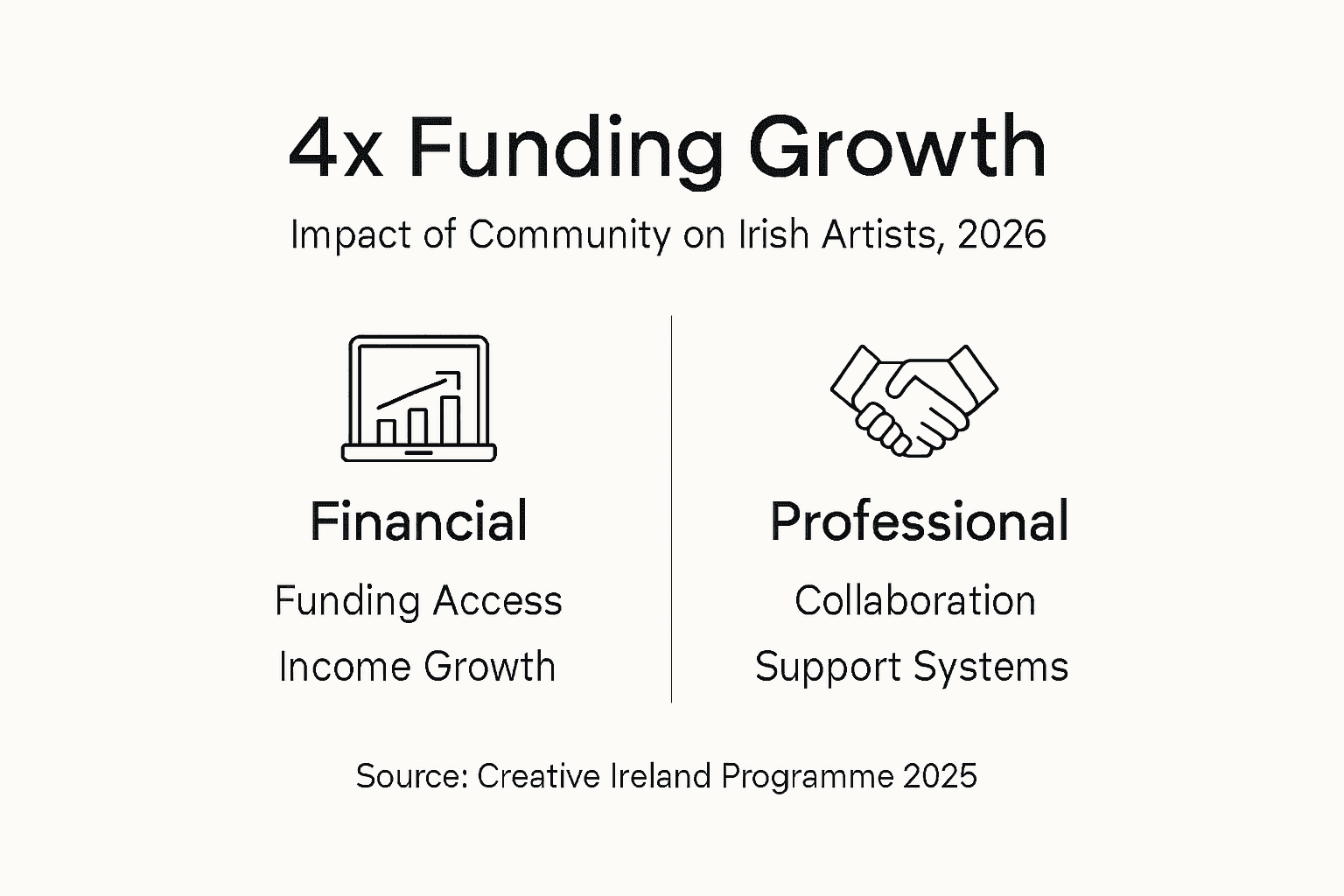
The Basic Income for the Arts pilot offers equally striking data. Recipients invest €550 more monthly into their creative practice and spend 8 additional hours weekly on artistic work compared to their previous situations. While the income itself matters, participants consistently report that community connections made through the programme amplify these benefits. They gain confidence, discover new markets, and develop business skills that outlast the pilot period.
Community engagement creates measurable professional growth beyond creative skills alone:
-
Increased confidence in pricing work appropriately for the Irish market
-
Access to peer knowledge about successful sales strategies and platforms
-
Connections to collaborative funding opportunities requiring partnership
-
Professional development through workshops and coaching focused on business sustainability
-
Reduced isolation leading to improved wellbeing and creative productivity
“The combination of financial support and community connection creates careers that can actually sustain artists long-term, not just fund individual projects.”
Platforms like The Biscuit Factory demonstrate this principle. Members report that structured peer support and expert coaching directly improve their pricing confidence and sales outcomes. Financial support alone doesn’t build sustainable careers. The knowledge, skills, and connections gained through community create the foundation for long-term profitability.
Collaborative Opportunities and Peer Knowledge Sharing
Ireland’s Creative Communities initiative has facilitated tangible collaboration at scale. The programme has delivered over 5,700 projects nationwide, creating cross-sector partnerships among artists, heritage groups, libraries, and enterprises. These aren’t merely social gatherings. They’re structured opportunities that generate income, build portfolios, and open market access.
Peer collaboration specifically improves business outcomes. When artists share knowledge about pricing strategies, they collectively raise standards and confidence. Peer collaboration increases sales outcomes and pricing strategy confidence among Irish artists who might otherwise undervalue their work. You learn what actually sells, which platforms work, and how to communicate value to customers.
Structured schemes facilitate these connections:
-
Artist-in-Community placements that pay while building local networks
-
Collaborative funding applications requiring partnership between creatives
-
Regional creative hubs offering workspace and peer interaction
-
Online communities providing business coaching and troubleshooting support
-
Cross-sector projects connecting artists with commercial opportunities
These mechanisms matter because isolation kills creative businesses. When you’re working alone, you have no benchmark for pricing, no feedback on sales approaches, and no one to celebrate wins or troubleshoot problems. Peer collaboration at The Biscuit Factory addresses this by connecting Irish creatives facing similar challenges, from VAT registration confusion to Instagram algorithm frustrations.
Collaborative projects also provide diverse income streams. A ceramicist partnering with a local library on workshops gains teaching income, portfolio pieces, and community visibility. A textile artist collaborating with heritage groups on exhibitions accesses funding while building commercial credibility. These opportunities rarely appear to artists working in isolation.
Common Misconceptions about Artist Community Roles
Many artists hesitate to engage with communities due to persistent myths. The most damaging misconception is that community limits artistic independence. Evidence shows collaboration within communities expands creative freedom rather than constraining it. When you have financial stability through better sales and funding access, you can take more creative risks. When peers validate your experimental work, you gain confidence to push boundaries.
Another myth positions artist communities as primarily social clubs with little business impact. This outdated view ignores the structured business support now central to effective creative communities. Platforms focused on business development provide coaching on pricing, sales strategy, and financial planning. These aren’t social benefits. They’re professional development directly impacting income.
Some artists believe they can thrive equally well alone, viewing community as optional. The data contradicts this. Isolation remains a challenge for many Irish artists, negatively affecting both wellbeing and business outcomes. Even highly successful artists benefit from peer networks that provide market intelligence, emotional support during slow periods, and collaborative opportunities that diversify income.
The reality is nuanced:
-
Community doesn’t require constant participation, just strategic engagement
-
Different communities serve different needs, from purely social to intensely business-focused
-
You retain complete creative control while gaining business support
-
Business-focused artist communities specifically address commercial challenges without dictating creative direction
Pro Tip: Choose communities that explicitly focus on business development rather than purely social connection. Your time is limited. Invest it where you’ll gain practical skills and income growth, not just camaraderie.
The key is matching community type to your specific needs and career stage. An emerging artist needs different support than an established maker expanding into wholesale. Choosing wrong wastes time and reinforces negative assumptions about community value.
Framework for Leveraging Community to Enhance Business Growth
Successful community engagement requires strategic evaluation. Frameworks use multiple KPIs to assess community impact including financial growth, time for art, wellbeing, and business confidence. This multi-metric approach prevents the common mistake of judging community solely on immediate income, missing crucial long-term benefits.
Consider this comparison between community-engaged and solo artists:
| Metric | Community-Engaged Artist | Solo Artist |
| Annual income growth | 15-25% through peer pricing knowledge and collaborative opportunities | 5-10% through individual effort alone |
| Weekly creative hours | 8+ additional hours via efficiency and confidence | Limited by isolation and business uncertainty |
| Funding access | 4x higher through community networks and application support | Baseline individual application success rates |
| Business confidence | High due to peer validation and expert coaching | Variable, often undermined by isolation |
| Wellbeing score | Improved through reduced isolation and shared challenges | Lower due to isolation and uncertainty |
Your decision criteria should include:
-
Does this community provide actionable business education or just networking?
-
Are members at similar career stages with relevant challenges?
-
Can I access expert coaching on pricing, sales, and financial planning?
-
Will participation create measurable income growth within 6-12 months?
-
Does the time investment align with my available capacity?
Artist community evaluation frameworks help you assess fit before committing. Look for communities offering structured onboarding, clear value propositions, and testimonials from members who’ve achieved specific business outcomes.
Pro Tip: Conduct quarterly self-assessments measuring community ROI against these metrics. If you’re not seeing improvement in at least three areas after six months, reassess your engagement strategy or community choice.
Strategic engagement avoids common pitfalls like joining every available group, spreading effort too thin, or staying in communities that no longer serve your growth. Your goal is sustainable business development, not maximum community participation.
Practical Steps for Irish Artists to Engage with Community Support
Ready to leverage community for business growth? Follow these sequential steps tailored to the Irish creative sector in 2026:
-
Connect with your local Culture and Creativity Team through the Creative Ireland Programme website. These teams are your gateway to regional funding, collaborative projects, and local artist networks.
-
Research and apply for relevant artist schemes. The Artist in the Community programme and Basic Income for the Arts pilot (if reopened) provide both funding and community connection. Application deadlines typically fall in early autumn.
-
Join The Biscuit Factory community for business-focused coaching, peer networking, and practical resources. The platform offers tiered membership matching different career stages and budgets.
-
Create an individual growth plan targeting specific business challenges. Use community resources to address pricing uncertainty, sales strategy, or business planning. Tools like the Pricing & Profit Calculator provide concrete starting points.
-
Engage consistently but strategically. Attend monthly coaching sessions, participate in relevant peer discussions, and implement one new business practice each quarter based on community learning.
-
Track your progress using the framework metrics: income growth, creative hours, funding access, confidence, and wellbeing. Adjust your community engagement based on results.
Pro Tip: Focus initial efforts on business-focused communities that match your career stage and specific challenges. An emerging artist needs pricing fundamentals and sales confidence. An established maker expanding into wholesale needs different strategies and connections.
The goal is building sustainable systems, not creating more work. Community should reduce overwhelm by providing clear guidance, not add to your task list. Choose platforms offering structured support rather than requiring you to figure everything out through unguided networking.
Conclusion: Building Sustainable, Profitable Artistic Careers through Community
The evidence is clear. Community engagement directly correlates with increased funding access, higher income, and improved wellbeing for Irish artists. The quadrupling of Arts Council funding, the measurable impact of the Basic Income pilot, and over 5,700 collaborative projects demonstrate that community isn’t optional for sustainable creative careers. It’s foundational.
Irish artists face unique challenges within a distinctive creative ecosystem. Isolation, business skill gaps, and pricing uncertainty undermine even the most talented creatives. Strategic community engagement addresses these barriers through peer knowledge sharing, expert coaching, and collaborative opportunities that diversify income and build professional confidence.
The framework and practical steps outlined here provide your roadmap. You now understand how to evaluate community fit, which metrics matter for business growth, and exactly how to engage with Irish creative support structures. The transformation from struggling solo artist to confident creative entrepreneur happens through strategic community leverage.
Your next step is simple. Identify one business challenge currently limiting your income or creative time. Then choose one community resource specifically addressing that challenge. This focused approach creates momentum without overwhelm.
The vision for Ireland’s creative future depends on artists recognizing community as essential business infrastructure, not optional social benefit. As more creatives strategically engage, collective knowledge grows, pricing standards rise, and the entire sector becomes more sustainable and profitable.
Discover Expert Support and Networking at The Biscuit Factory
You’ve learned how community transforms creative businesses. Now it’s time to experience that transformation yourself. The Biscuit Factory platform offers Irish artists and makers exactly what you need: practical business coaching, peer support from creatives facing similar challenges, and resources designed specifically for the Irish creative sector.
Members access live coaching sessions on pricing, sales strategy, and business planning. You’ll connect with peer networks through the members directory who understand the unique challenges of building a creative business in Ireland. Tools like the Pricing & Profit Calculator provide immediate practical value, while ongoing workshops and Q&A sessions keep you current with market changes and opportunities. Join The Biscuit Factory community today to bridge knowledge gaps and start building the profitable, sustainable creative career you deserve.
Frequently Asked Questions
What funding programmes are available through Irish artist communities?
The Arts Council offers individual artist grants, bursaries, and project funding, with community connection significantly improving success rates. The Artist in the Community scheme provides paid placements. Culture and Creativity Teams at local authority level manage regional funding streams. Community platforms often provide application support and grant writing guidance that dramatically increases your chances of securing funding.
How do I find local Culture and Creativity Teams near me?
Visit the Creative Ireland Programme website and select your county from the interactive map. Each of Ireland’s 31 local authorities has a dedicated team with contact details and information about local creative initiatives. You can also contact your local authority directly and ask for the Culture and Creativity officer. These teams are your primary gateway to regional funding, collaborative projects, and local artist networks.
Can community participation fit into a busy creative schedule?
Absolutely. Strategic engagement doesn’t require constant participation. Focus on high-value activities like monthly coaching sessions, quarterly planning workshops, and targeted peer discussions addressing your specific challenges. Many communities offer recorded sessions for flexibility. The time you invest in learning better pricing or sales strategy saves hours previously spent on ineffective approaches.
What if I’m an emerging artist unsure about business skills?
Business-focused communities specifically serve emerging artists building foundational skills. You’ll find step-by-step guidance on essential topics like pricing, VAT registration, and sales platforms. Peer support from other emerging artists normalizes the learning process. Expert coaching provides clear answers to specific questions. Everyone starts somewhere. Communities accelerate your learning curve by providing proven frameworks rather than forcing you to figure everything out alone.
Does community help reduce the isolation many Irish artists face?
Yes, significantly. Community connection directly addresses isolation by providing regular interaction with peers who understand your challenges and celebrate your wins. This isn’t just emotional support. Reduced isolation improves creative productivity, business confidence, and overall wellbeing. You gain perspective during slow periods and accountability to keep moving forward. The combination of peer connection and professional development creates both business growth and personal sustainability.