

Growing a creative business in Ireland often feels unpredictable, especially when artistic passion meets the realities of income and sustainability. Structured career planning matters because a clear vision shapes both artistic expression and long-term success. Discover proven methods for developing a creative growth plan that connects skill development, financial stability, and professional opportunity, helping Irish artists and makers transform individual talent into thriving, profitable enterprises.
Table of Contents
- Defining Creative Growth Plans for Artists
- Types and Formats of Growth Plans
- Core Elements and How They Work
- Practical Applications for Irish Creatives
- Common Mistakes and Pitfalls to Avoid
- Costs, Risks, and Sustainability Factors
Key Takeaways
| Point | Details |
|---|---|
| Creative Growth Plans are Essential | Artists need structured growth plans for sustainable development and economic stability in their careers. |
| Core Elements Drive Success | Focus on talent development, financial investment, and market research to foster professional growth. |
| Customization is Key | Tailor growth plans to individual artistic disciplines and market demands for effective outcomes. |
| Avoid Common Pitfalls | Recognize mistakes like unrealistic goals and lack of adaptability to create more robust strategies. |
Defining Creative Growth Plans for Artists
A creative growth plan serves as a strategic roadmap for artists seeking sustainable professional development and economic stability. Creative industry frameworks outline these plans as comprehensive strategies designed to nurture artistic talent while establishing clear pathways for business expansion and economic contribution.
At its core, a creative growth plan encompasses several critical components that transform artistic passion into a viable career trajectory:
- Financial Planning: Developing realistic revenue models
- Skills Development: Identifying and acquiring new professional capabilities
- Market Positioning: Understanding target audiences and competitive landscapes
- Professional Networking: Building strategic connections within creative industries
- Business Infrastructure: Creating systems for consistent artistic production and monetization
Understanding the significance of structured career planning is crucial. European policy research747426_EN.pdf) indicates that artists who implement comprehensive growth strategies are significantly more likely to achieve long-term professional sustainability and economic resilience.
Successful creative growth plans are not one-size-fits-all but require personalized approaches tailored to individual artistic disciplines, career stages, and professional goals. These plans must remain flexible, allowing artists to adapt to changing market dynamics while maintaining a clear strategic vision.
Pro tip: Create a quarterly review process to assess and recalibrate your creative growth plan, ensuring continuous alignment with your evolving artistic and professional objectives.
Types and Formats of Growth Plans
Growth plans for creative entrepreneurs come in diverse formats, each tailored to specific professional needs and strategic objectives. Creative industry strategies demonstrate that successful plans are not uniform but dynamically structured to support individual artistic trajectories.
These growth plans typically fall into several distinct categories:
- Sector-Specific Plans: Customized strategies for particular creative disciplines
- Regional Development Plans: Focused on local creative ecosystem support
- Innovation-Driven Frameworks: Emphasizing technological adaptation and skill advancement
- Collaborative Stakeholder Models: Involving multiple partners and institutional support
- Investment-Oriented Strategies: Targeting financial sustainability and resource allocation
Collaborative policy initiatives reveal that the most effective growth plans integrate multiple approaches, creating comprehensive roadmaps that address both artistic development and economic sustainability.
The complexity of growth plans varies significantly. Some artists might develop simple one-year tactical plans focusing on immediate skill enhancement, while others construct multi-year strategic frameworks involving detailed market analysis, professional networking, and progressive skill acquisition.

Here's how different types of creative growth plans address distinct needs:
| Plan Type | Strategic Focus | Best For |
|---|---|---|
| Sector-Specific | Tailors to artistic discipline | Specialized artists |
| Regional Development | Local market growth | Community-focused creatives |
| Innovation-Driven | Technology adoption | Early tech adopters |
| Collaborative Stakeholder | Shared resources & support | Multi-partner projects |
| Investment-Oriented | Financial scaling | Entrepreneurs seeking funding |
Pro tip: Design your growth plan as a living document, allowing flexibility for periodic reassessment and strategic pivots based on emerging opportunities and personal evolution.
Core Elements and How They Work
A successful creative growth plan integrates multiple core strategic elements that work synergistically to support artistic and professional development. Creative industry strategies demonstrate how these interconnected components create robust frameworks for sustainable career progression.
The fundamental core elements of an effective growth plan include:
- Talent Development: Continuous skills enhancement and professional learning
- Innovation Promotion: Adopting emerging technologies and creative methodologies
- Financial Investment: Securing resources and exploring funding opportunities
- Market Research: Understanding industry trends and audience dynamics
- Networking Infrastructure: Building strategic professional connections
- Personal Branding: Cultivating a distinct professional identity
Creative sector research reveals that these elements operate as an interconnected ecosystem, where improvement in one area catalyzes advancement across multiple dimensions of professional practice.
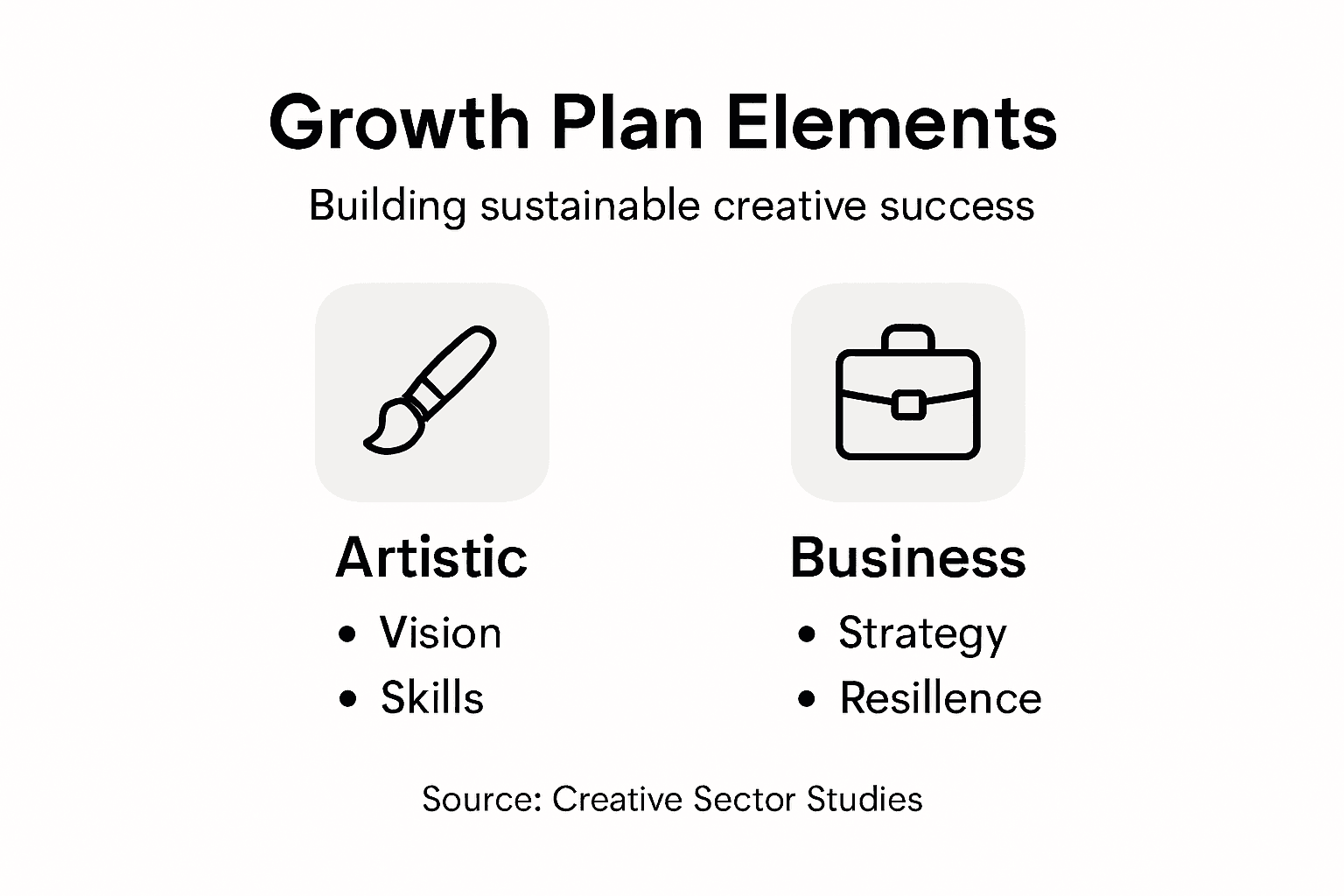
Successful implementation requires artists to approach these elements holistically, recognizing that growth is not linear but a dynamic, adaptive process. Each element demands consistent attention, periodic reassessment, and willingness to experiment with new strategies that align with emerging opportunities.
Pro tip: Create a quarterly tracking dashboard that monitors progress across each core element, enabling data-driven adjustments to your growth strategy.
Practical Applications for Irish Creatives
Creative entrepreneurs in Ireland face unique challenges that demand tailored growth strategies specifically adapted to the local artistic landscape. Irish creative community networks provide crucial support mechanisms for transforming individual artistic visions into sustainable professional practices.
Practical application of growth plans for Irish creatives requires focusing on several key strategic approaches:
- Local Market Understanding: Deeply researching Irish artistic ecosystems
- Cultural Contextualization: Aligning creative work with Irish cultural narratives
- Funding Navigation: Identifying Irish-specific grants and creative development resources
- Network Cultivation: Building meaningful connections within Irish creative industries
- Digital Infrastructure: Developing online presence tailored to Irish audience expectations
- Regulatory Compliance: Understanding Irish creative sector legal and professional frameworks
Successful implementation involves recognizing the intricate balance between artistic integrity and commercial viability. Irish creatives must craft growth plans that honor traditional artistic values while embracing innovative approaches that expand professional opportunities.
The most effective growth strategies integrate personal artistic vision with pragmatic business development, creating a holistic approach that supports both creative expression and economic sustainability.
Pro tip: Develop a growth plan that includes both quarterly artistic goals and measurable business milestones, ensuring a balanced approach to professional development.
Common Mistakes and Pitfalls to Avoid
Creative entrepreneurs frequently encounter systemic challenges that can derail their growth strategies. Research on creative industry risks highlights critical mistakes that consistently undermine professional development and economic sustainability.
The most prevalent mistakes in creative growth planning include:
- Unrealistic Expectations: Setting unachievable financial or professional goals
- Lack of Financial Planning: Neglecting comprehensive budget management
- Skill Stagnation: Failing to continuously update professional capabilities
- Network Undervaluation: Overlooking the importance of strategic professional relationships
- Market Misalignment: Creating work disconnected from audience or market demands
- Insufficient Adaptability: Rigidly adhering to initial plans without flexibility
Professional growth requires a nuanced understanding that creative success is not linear. Artists must develop resilience, embracing setbacks as opportunities for learning and strategic recalibration, rather than viewing them as insurmountable obstacles.
Understanding these potential pitfalls enables creative professionals to design more robust, adaptive growth strategies that anticipate and mitigate potential challenges before they become significant barriers to success.
Pro tip: Conduct monthly self-assessments of your growth plan, identifying potential weaknesses and proactively developing contingency strategies.
Costs, Risks, and Sustainability Factors
Creative entrepreneurship demands a comprehensive understanding of financial risks and sustainable development strategies. Creative industry investment plans reveal complex economic dynamics that artists must navigate carefully.
Key sustainability factors for creative professionals encompass:
- Financial Resilience: Building diverse income streams
- Risk Mitigation: Developing adaptable business models
- Skills Investment: Continuous professional development
- Market Diversification: Reducing dependency on single revenue sources
- Technology Adaptation: Staying current with digital innovations
- Economic Flexibility: Creating scalable professional frameworks
European artist sustainability research highlights the critical importance of understanding economic precarity and proactively designing career strategies that provide long-term stability.
Successful creative entrepreneurs recognize that sustainability is not a destination but an ongoing process of strategic planning, continuous learning, and responsive adaptation to changing market conditions.
Review this concise comparison of sustainability factors for creative professionals:
| Factor | Importance | Action Step |
|---|---|---|
| Financial Resilience | Income security | Build multiple revenue streams |
| Risk Mitigation | Managing uncertainty | Regular plan assessments |
| Skills Investment | Staying competitive | Ongoing professional learning |
| Market Diversification | Broader opportunities | Explore new audiences |
| Technology Adaptation | Relevance | Update digital tools regularly |
Pro tip: Allocate at least 10% of your annual income to professional development and emergency financial reserves to enhance long-term economic resilience.
Unlock Your Creative Growth with Support Tailored for Irish Artists
Building a sustainable creative career requires more than passion. The challenges of realistic financial planning, continual skills development, strategic networking, and market alignment discussed in the article are exactly what many Irish creatives face every day. If you are ready to transform your artistic vision into a profitable and adaptable business, understanding these core elements is the first step. The Biscuit Factory offers practical solutions designed to help you navigate these very challenges with confidence.
Join The Biscuit Factory to access live coaching, tailored workshops, and proven business tools that focus on pricing, sales strategies, and personalized growth plans. Benefit from a supportive community that eliminates algorithm distractions so you can concentrate on what matters most: your creative and economic success. Start mapping out your 2026 creative growth plan today and take charge of your career with expert guidance and peer support. Don’t wait — your sustainable creative future starts now at The Biscuit Factory where Irish creatives grow smarter together.
Frequently Asked Questions
What is a creative growth plan?
A creative growth plan is a strategic roadmap for artists to enhance their professional development and establish sustainable career paths. It includes components like financial planning, skills development, market positioning, and networking.
Why is financial planning important for artists?
Financial planning helps artists develop realistic revenue models and manage their budgets effectively, ensuring long-term economic stability and the ability to invest in their personal and professional growth.
How can I create a personalized growth plan as an artist?
To create a personalized growth plan, assess your current skills and market position, define your artistic and professional goals, and incorporate core elements such as talent development, innovation, and networking.
What common mistakes should I avoid in my creative growth plan?
Common mistakes include setting unrealistic expectations, lacking financial planning, failing to continuously develop skills, undervaluing professional networking, and being inflexible with your strategies.
Recommended
- The Biscuit Factory | Ireland's Independent Creative Community | The Biscuit Factory
- The Biscuit Factory - Ireland's Independent Creative Community | Irish Artists & Makers
- The Biscuit Factory - Ireland's Independent Creative Community | Irish Artists & Makers
- Efficiëntie in Luxe Boten: Duurzaam Varen Zonder Concessies – Dobber Boats