

For many Irish artists, turning creative talent into reliable income can feel frustrating when industry definitions keep shifting. The blurred boundaries between cultural and creative sectors often mean that traditional art forms are left out of formal support structures, making it harder to find your way. By understanding and shaping your own creative business model, you open the door to new ways of earning and matching your unique strengths with opportunities in the Irish market.
Defining Creative Business Models for Artists
A creative business model is how you make money from your artistic work. It's not just about selling finished pieces—it's the entire structure of how you create value, deliver it to customers, and generate income from that process.
For Irish artists, understanding this distinction matters because your business model shapes everything else. It determines your pricing, your time commitment, your scalability, and ultimately, whether you can make sustainable income from your creative practice.
The challenge lies in the fact that definitions of creative industries remain inconsistent, often excluding traditional art forms like theatre, music, and publishing from formal "creative industry" classifications. This gap means many Irish artists operate outside traditional support structures, requiring them to build their own business frameworks.
Creative business models can take many shapes:
- Direct sales: Selling your work directly to customers (paintings, jewellery, prints)
- Service-based: Offering your skills for hire (illustration, design, copywriting)
- Licensing: Allowing others to use your work for a fee (music, photography, designs)
- Membership or subscription: Offering exclusive content or access to patrons
- Hybrid models: Combining two or more approaches (selling originals plus offering workshops plus teaching)
- Digital products: Creating downloadable or online offerings (courses, templates, presets)
The key is matching your model to your strengths, your market, and your lifestyle. An animator's model looks different from a potter's, which looks different from a copywriter's.
Your business model isn't fixed—it evolves as your income grows and your priorities shift.
Many successful Irish creatives use more than one income stream. This approach reduces dependency on a single revenue source and creates natural stability when one stream fluctuates seasonally.
When defining your model, ask yourself these questions:
- Which activities energise you most?
- Where does your audience already spend time or money?
- What can you scale without burning out?
- Which approach aligns with how you want to work?
- What initial investment does each model require?
Your answers will shape whether you focus on high-volume, low-price work or limited-edition, premium offerings—and that distinction affects everything about your business strategy.
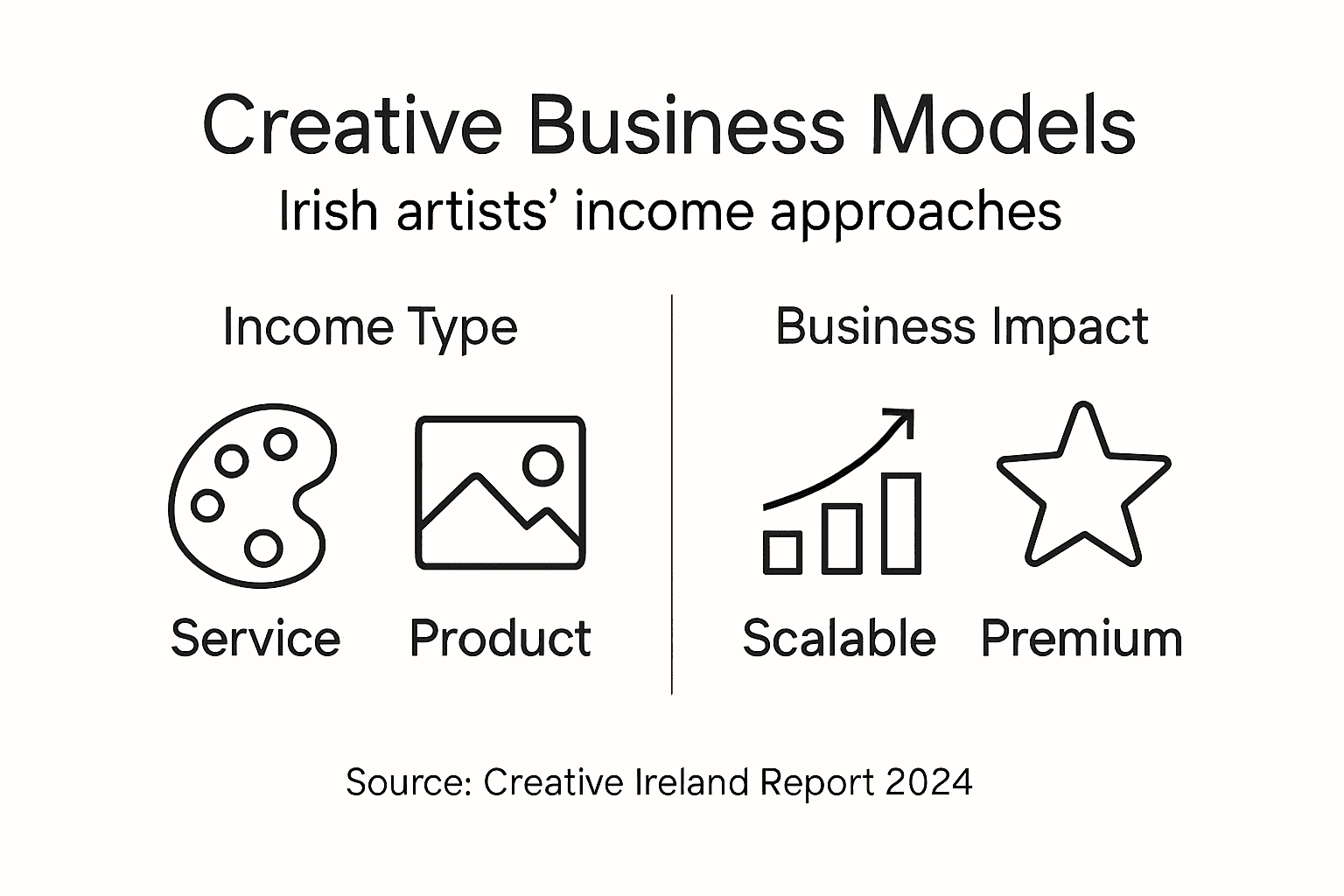
Here's a summary of creative business model types and their unique business impacts:
| Model Type | Typical Income Approach | Scalability Potential | Business Impact |
|---|---|---|---|
| Direct sales | Sell finished artworks | Limited—one-off items | Immediate cash but labour-intensive |
| Service-based | Trade time for expertise | Moderate—depends on workload | Quick income, less passive |
| Licensing/Rights | Fees for intellectual property | High—work earns repeatedly | Reaches new markets easily |
| Membership/Subscription | Ongoing patron support | Moderate—dependent on audience | Stable recurring revenue |
| Hybrid models | Combine multiple strategies | Variable—depends on mix | Balanced risk, enhanced flexibility |
| Digital products | Online courses, downloads | High—minimal ongoing effort | Potential for passive income |
Pro tip: Write down three potential income streams you could offer within your creative practice, then test the smallest one first to see what actually resonates with your audience before fully committing your time.
Exploring Key Models and Income Streams
Once you understand what a creative business model is, the next step is choosing which income streams work best for your situation. Most successful Irish creatives don't rely on just one revenue source—they build a portfolio of income that complements their main practice.
The most common models break down into three primary categories that form the foundation of creative income:
- Product-based income: Selling tangible or digital items you create once and sell repeatedly (prints, courses, digital designs)
- Service-based income: Trading your time and expertise directly (commissions, freelance work, consulting, workshops)
- Rights-based income: Earning from others using your intellectual property (licensing, royalties, subscriptions)
Each model has different time requirements, scalability potential, and upfront investment. The Digital Creative Industries Roadmap for Ireland emphasises diverse revenue models spanning product sales to service provision, recognising that no single approach suits every creator.
Combining income streams creates stability—when one dips seasonally, others sustain your business.
Consider how each model fits your circumstances:
For quick cash flow: Service-based work generates immediate payment. Clients pay when they hire you, so money arrives faster than waiting for product sales.
For passive income: Product models work best once created. You build once, sell many times, requiring minimal ongoing effort per sale.
For market expansion: Licensing and rights-based models let you reach new audiences without creating new work. Your illustration could earn royalties across multiple platforms.
The reality is that adaptive business models addressing technological change remain critical for Irish creatives competing in European and global markets. This means your model should flex as trends shift and new opportunities emerge.
Many Irish artists start service-based (taking commissions) because it's immediate, then gradually build product lines alongside as their reputation grows. This layered approach reduces financial pressure while building sustainable income.
The right combination depends entirely on your answers to these questions:
- How quickly do you need income?
- How much time can you invest upfront with no immediate return?
- What aspect of your work scales most naturally?
- Where does your audience show strongest buying behaviour?
Pro tip: Map your current income sources and identify one gap you could fill within the next three months—perhaps adding a digital product to service work, or licensing existing designs you've already created.
Innovations in the Irish Creative Sector
The Irish creative sector is transforming rapidly. Government investment, technological advancement, and shifting audience behaviour are opening new pathways for artists and creators to build sustainable income.
These aren't distant changes happening elsewhere—they're happening now, in Ireland, creating real opportunities for your business.
The Digital Creative Industries Roadmap focuses on growth sectors like games and immersive technologies, recognising where Ireland has competitive advantage and where demand is genuinely growing. This means resources are flowing toward these areas, making them viable income sources if you can adapt your skills.
Key innovation areas reshaping creative income:
- Digital and immersive technologies: AR, VR, and metaverse experiences create demand for designers, developers, and storytellers
- Content creation across platforms: Short-form video, podcasting, and streaming demand creators at scale
- Strategic design services: Brands increasingly need design-led problem solving, not just visual work
- Game development and interactive media: Both indie and commercial opportunities expanding rapidly
- Cross-sector collaboration: Creative skills combining with green initiatives and regional development projects
Innovation doesn't mean abandoning what you do—it means finding new contexts where your existing skills earn income.
The Creative Ireland Progress Report 2024 emphasises investment in local creative communities and youth support, meaning funding and collaboration opportunities are expanding across Ireland, not just Dublin.
This matters for your business model because it signals where clients and audiences are investing attention. Digital games employers are hiring. Immersive technology studios are growing. Streaming platforms need content creators.
None of this requires you to abandon your core practice. A traditional illustrator can now license work for gaming assets. A sculptor can create digital versions for metaverse galleries. A musician can build direct audience relationships through multiple platforms simultaneously.
The innovation question for you is simpler: Where are your existing skills meeting emerging demand?
- What technology or platform is your audience already using?
- Could your current work adapt to that platform?
- What complementary skills could you develop in 3-6 months?
- Which emerging sectors align with your interests, not just market trends?
You don't need to chase every trend. But understanding what's shifting helps you position yourself ahead of saturation.
Pro tip: Identify one emerging platform or format your target audience is actively using, then spend one month experimenting with your work in that format before committing time or money to it.
Common Challenges and How to Avoid Them
Every creative business model faces obstacles. The difference between sustainable income and burnout is anticipating these challenges and building defences before they derail your work.
Irish creatives face specific pressures that aren't always obvious until you're deep in your business. Understanding them means you can plan around them rather than scrambling when they hit.
The primary challenges affecting creative businesses centre around four areas:
- Economic pressures: Rising energy costs, VAT changes, and economic uncertainty squeeze margins and client spending
- Labour and skills gaps: Finding skilled collaborators or team members becomes difficult as demand grows
- Market saturation: More creators means more competition for audience attention and client budgets
- Operational strain: Managing multiple income streams, platforms, and client relationships without burning out
Irish SMEs specifically face rising energy costs and VAT rate changes affecting profitability, which means your pricing and cost structure need buffer room built in from the start.
Build resilience into your model before crisis forces you to scramble.
The most dangerous challenge isn't any single problem—it's ignoring warning signs until they compound. A client payment delay becomes a cash flow crisis. An underpriced service becomes chronic underearning. A single platform dependency becomes catastrophic when algorithms shift.
How to avoid the most common pitfalls:
Pricing too low: Many creatives underestimate their value. Once you undercut the market, raising prices feels impossible. Price for profit from project one, not as a growth strategy.
Relying on one income stream: When that stream dries up, everything stops. Build redundancy deliberately into your model.
Ignoring operational costs: Digital products still require hosting. Service work requires tools, software, and time for administration. Calculate your full costs before setting prices.
Scaling without systems: Working harder isn't sustainable. If your model doesn't have systems that work without your constant input, you're trading time for money indefinitely.
Regarding climate and supply chain impacts on Irish businesses, creative businesses depending on physical products need contingency plans for disruptions. This might mean diversifying suppliers, building inventory buffers, or shifting partially toward digital alternatives.
The challenge question for your business: What would happen if your primary income stream disappeared for three months?
If the answer terrifies you, that's your warning sign to build a second stream now.
To help Irish artists choose resilient models, here's a comparison of key challenges and practical solutions:
| Challenge Area | Why It Matters | Solution Approach |
|---|---|---|
| Economic pressures | Squeezes margins and client budgets | Adjust pricing, build financial buffer |
| Skills gaps | Hinders collaboration and growth | Invest in training and upskilling |
| Market saturation | Increases competition | Differentiate, target niche markets |
| Operational strain | Risk of burnout and inefficiency | Develop systems, outsource tasks |
Pro tip: Document your three highest operational expenses this month, then identify one way to reduce each by 10-15% without compromising quality—this buffer protects you when income fluctuates.
Building Resilience and Sustainable Success
Sustainable income isn't about one big win. It's about building a business model that survives setbacks, adapts to change, and generates steady revenue without consuming your health or happiness.
Resilience means your business keeps functioning even when one element fails. A client stops paying. A platform changes its rules. Your energy costs spike. You get sick for a month. None of these should collapse your entire income.
The foundation of resilience rests on three pillars:
- Diversified income: Multiple revenue streams so no single source dominates
- Operational systems: Processes that work without your constant hands-on involvement
- Financial buffers: Savings and pricing that absorb unexpected costs
- Continuous adaptation: Regular review and adjustment of what's working
Government support structures now emphasise sustainable employment within creative industries through collaborative industry initiatives, meaning mentorship, funding, and networking resources exist to help you build sustainable practices.
Resilience isn't built during crisis—it's built when things are working well.
Screencraft and creative sector strategies highlight the importance of addressing global challenges by enhancing industry capacity and supporting creative talent, which signals that Irish institutions increasingly recognise sustainability as a strategic priority, not a luxury.
Practical steps to build resilience now:
Document your systems: How do you deliver work? How do you find clients? How do you manage finances? Write these down so they don't disappear if you take time off.
Create a three-month runway: Save enough to cover three months of essential expenses. This buys you time if income drops unexpectedly.
Price for sustainability: Include buffer room in your pricing for costs, taxes, sick days, and slow seasons. Lean pricing leaves no margin for error.
Review quarterly: Every three months, assess what's working. Which income streams are reliable? Which feel fragile? Adjust accordingly.
Build relationships: Your professional network is insurance. When one client disappears, your network provides alternatives.
Sustainable success doesn't mean rapid growth. It means year-on-year stability where you control your time and income, not the other way around.
Pro tip: Calculate your minimum monthly income requirement, then build your pricing and income streams to comfortably exceed that by 30-40%, creating built-in resilience for unexpected costs or client gaps.
Build Resilience and Grow Your Income with The Biscuit Factory
The article highlights the challenges Irish creatives face in defining sustainable business models and managing multiple income streams to build durable success. If you find yourself unsure about how to diversify your revenue or how to price your work effectively to withstand economic pressures, you are not alone. Key pain points like operational strain, market saturation, and the need for adaptable business models require practical guidance and a supportive network. Whether you want to focus on service-based income or explore digital products and licensing, understanding your unique strengths and market fit is essential.
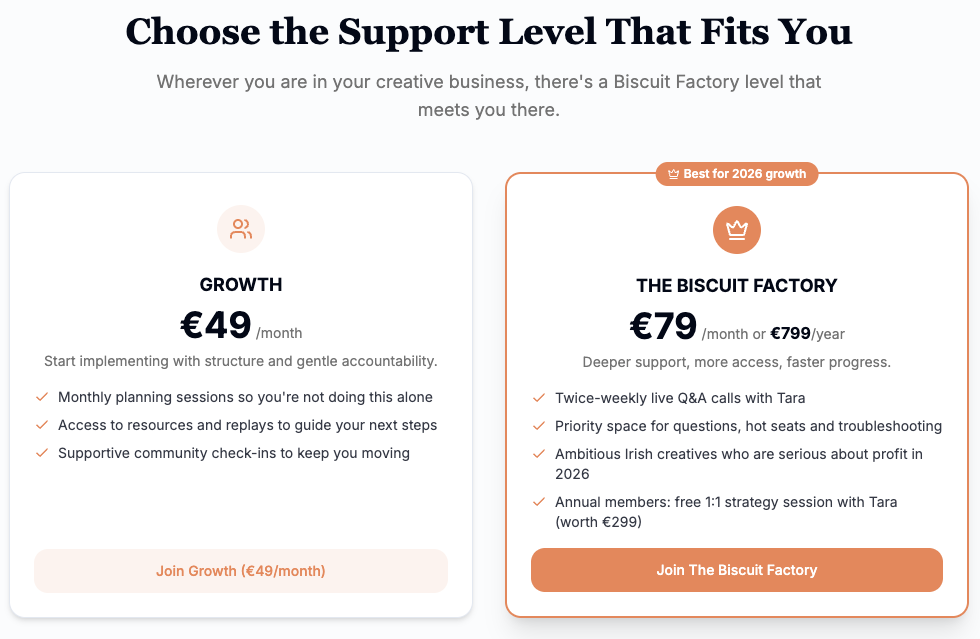
At The Biscuit Factory, we offer tailored coaching, workshops, and step-by-step planning sessions designed specifically for Irish artists and creative entrepreneurs who want to gain clarity and confidence in building profitable, scalable businesses. Join our community to access expert advice on pricing strategies, business planning, and diversifying income streams while connecting with peers facing similar challenges. There is no better time than now to future-proof your creative career and start mapping out your growth for 2026. Explore more about how to advance your creative business on our blog and discover resources crafted for your success at The Biscuit Factory.
Frequently Asked Questions
What are creative business models?
Creative business models are frameworks through which artists generate income from their work. They encompass various methods of creating value, delivering it to customers, and earning revenue, such as direct sales, service offerings, and licensing.
How can I determine the best income stream for my artistic practice?
To find the best income stream, consider what activities energise you, where your audience spends their money, what you can scale without burnout, and the initial investment required for each model. Evaluating these factors will help tailor your approach to your strengths.
What are some common income models for artists?
Common income models include product-based income (selling tangible or digital items), service-based income (trading time for expertise), and rights-based income (earning from licensing and royalties). Many successful artists utilise a combination of these to diversify their revenue.
How can I avoid common challenges when implementing a creative business model?
To avoid challenges, price your services appropriately from the start, avoid relying on a single income stream, keep track of your operational costs, and implement systems that allow your business to function without excessive involvement from you. Regularly assessing your income sources and market conditions can also help mitigate risks.